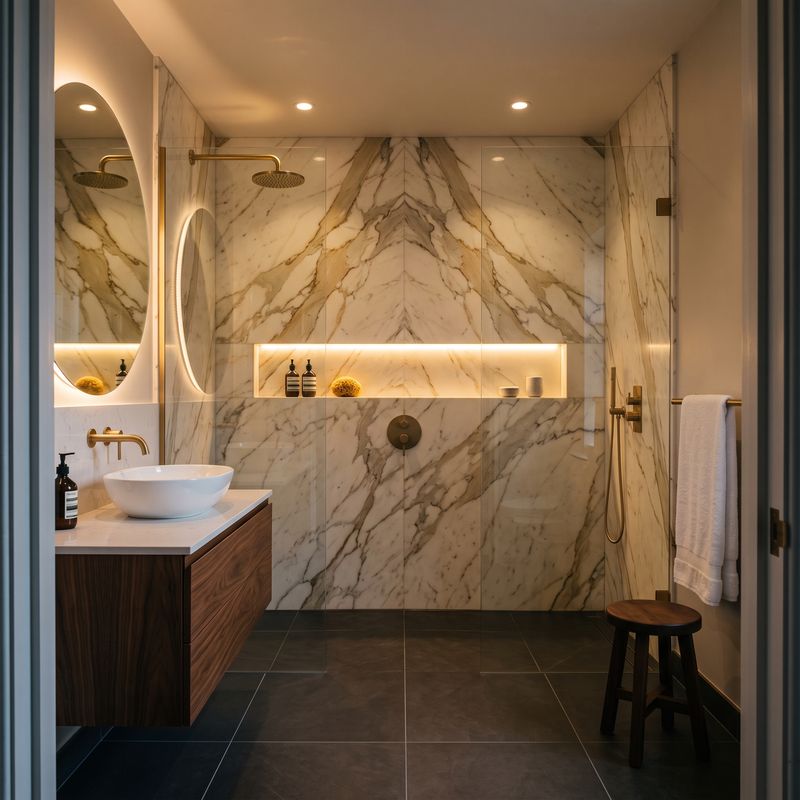
The short answer: a porcelain slab shower uses huge, thin porcelain panels (I install them in all sizes, up to 10 feet long) instead of tiles, so your walls have a seam or two instead of a grid of grout lines. You get the look of a marble slab with the toughness and low upkeep of porcelain. The catch: slabs need a very flat substrate, careful templating, special handling and an installer who has done it before. Fewer pieces does not mean an easier job.
I install porcelain slabs in showers, on fireplaces and on feature walls in Burlington, Oakville and Halton. Here’s what I want you to know before you fall in love with one at the showroom (which you will).
What is a porcelain slab, exactly?
It’s porcelain, the same dense, low-absorption material as good porcelain tile, made in very large, thin sheets. Panels come in a range of sizes, and I install thin porcelain panels of all sizes, up to 10 feet. Thicknesses are commonly around 6 mm, though they vary by maker. Mike to confirm the panel thicknesses you most often install
Most slab showers use marble-look or stone-look designs: Calacatta, Statuario, panda, onyx, concrete.
Why homeowners choose slab showers
- Almost no grout lines. Less scrubbing, nothing to discolour, and a calm, seamless look.
- Continuous veining. One panel can run floor to ceiling. Two panels can be book-matched, so the veining mirrors like an open book.
- Low maintenance. Porcelain doesn’t need sealing the way real marble does, and acidic cleaners won’t etch it.
- Wraps and mitres. Panels can be cut and mitred at corners, niches and benches so the pattern flows around the room.
Our Headon Forest shower is a good example: gold-veined Calacatta-look slab walls, a lit niche, a floating bench and brushed-gold fixtures. The Waterdown “panda” bathroom wraps bold black-and-white veining across walls, floor and the shower step.
What makes slabs harder than tile
Flatness
A slab is a giant, rigid sheet. It won’t bend to follow a wavy wall. The wall has to be flat before the slab goes up, or you’ll get gaps behind it and edges that don’t meet. Laticrete’s large-format guidance (TDS 193), citing the TCNA Handbook, allows no more than 1/8 inch of variation in 10 feet for tile with an edge 15 inches or longer. With panels up to 10 feet, I treat flat as non-negotiable. (Why flat isn’t the same as level)
Templating and cutting
Every cut matters when one panel is the whole wall. Valve holes, niches, the ceiling line and out-of-square corners all get measured and planned before the first cut. Mistakes aren’t a lost tile; they’re a lost panel.
Handling and access
Panels are heavy and flexible until they’re set. They’re moved with special frames and vacuum lifters, and it usually takes more than one person. Getting them up a narrow staircase or around a tight hallway corner is part of the plan. Mike to confirm how many people typically handle a panel on your jobs
Coverage
Slabs need full mortar contact on the back and on the wall, so there are no hollow spots. I use Laticrete MULTIMAX Lite, a large-and-heavy-tile mortar (ANSI A118.15HET) that Laticrete calls ideal for gauged porcelain panels, builds for non-sag on walls, and lists as an approved mortar over Hydro Ban. It’s keyed into the wall, combed in one direction and back-buttered on the panel, per Laticrete’s current installation instructions. Laticrete and the Ceramic Tile Education Foundation both point to 95% coverage in showers. Five dabs of mortar behind a slab is how the cookie monsters do it, and it’s how slabs crack. (Pancake Pros & Cookie Monsters)
What goes behind a slab shower
Same as every shower I build: a custom-sloped cement mortar bed on the floor, never a foam pre-slope or foam tray, with a Laticrete Hydro Ban membrane over it and on the walls, and no traditional liner pan. The drain comes from Shower Grate Shop: a drain compatible with Hydro Ban, per Laticrete and the drain maker’s instructions. Once the Hydro Ban has cured per Laticrete, it gets an overnight flood test before anything is set. Slabs make it even more important, because once those panels are up, nobody is getting behind them easily. (How a flood test works)
Why cement, not foam? Foam pre-slopes work when installed to their maker’s instructions, but a hand-packed cement bed lets me tune the slope to the panels and the drain. With Laticrete 3701, wire mesh in the bed and rebar in the curb, it’s crazy over-built.
The shower floor with slab walls
Slab walls don’t automatically mean a slab floor. Floors need slope and grip. Common options:
- Large-format tile with a linear drain following a single slope. (Curbless Shower Guide)
- A matching mosaic in the same look, which handles a centre drain and gives better grip.
- Slab on the floor in some layouts, with a textured finish and careful slope planning. Ask about this one early.
The moment I love on a slab job is the first panel going up. Up to that point it’s all measuring, flattening and planning, and the client is wondering what I’ve been doing all day. Then a 5x10 sheet of veining lands perfectly on the wall and they get it. The hardest part of a slab shower is the part you never see. That’s also why I get called to finish jobs where big tile beat the first installer. Rui R. wrote in his Google review about a previous setter who had trouble cutting his 2x4-foot tiles before I came in and finished the job.
Planning tips before you order slabs
- See the actual panels. Veining varies panel to panel. If you want book-matching, the panels need to be sequential from the same batch.
- Plan the seams. Decide where the seams land (corners are ideal) before cutting. A good installer will sketch a seam layout.
- Plan the niche. A niche cut from the same panel, with mitred edges, keeps the veining flowing. Lit niches look incredible against slab.
- Order spare material. Breakage happens even with perfect handling.
- Measure access. Stairs, landings and door widths, before the delivery truck shows up.
- Try the look first. Our free Bathroom Reno Visualizer can show a slab look on a photo of your own bathroom.
Questions to ask your slab installer
- How many slab showers have you installed? Can I see in-progress photos?
- How will you get my walls flat enough?
- What thinset and coverage method will you use?
- Where will the seams go, and how will you finish the edges?
- What waterproofing goes behind the panels, and will you flood test it?
Frequently asked questions
Are porcelain slab showers worth it?
If you want the look of stone with almost no grout and low upkeep, they’re hard to beat. They cost more than standard tile because of the material, handling and skill involved, so many people use slab on the shower walls and tile elsewhere.
Do porcelain slab showers have grout?
Very little. There are seams where panels meet and at corners, usually filled with colour-matched grout, epoxy or silicone depending on the location and the maker’s instructions. Compared to tile, it’s almost grout-free.
Is a porcelain slab the same as a quartz or marble slab?
No. Porcelain slabs are thin fired porcelain. Quartz is an engineered stone, and marble is natural stone. Porcelain is lighter and thinner than a stone slab, resists etching and doesn’t need sealing like marble.
Can porcelain slabs go over existing tile?
I don’t recommend it in a shower. You want to see and rebuild the waterproofing, and the old tile rarely gives you the flatness slabs need.
How long does a slab shower take?
It depends on the room, the prep and the panel lead time. Slab jobs need more time for templating and flattening, plus cure times for the waterproofing and a flood test. Your installer should give you a phase-by-phase schedule.
Slab showers are a highlight of our custom bathroom renovations in Halton.
Talk to Mike
Dreaming of a slab shower in Burlington, Oakville or Halton? Call Mike at 289-337-1578 or book a consult. See more of our panel work on Slab Installations. Every job comes with a 25-year warranty on tile-setting workmanship.
Sources
- American Concrete Institute FAQ, air voids vs strength (~5% per 1%): concrete.org/frequentlyaskedquestions.aspx?faqid=657
- Laticrete 3701 data sheet (DS-100-1026), mixing: 2 to 3.2 quarts water per 60 lb bag for floor beds: cdnmdm.laticrete.com/Datasheet/NA/20/Datasheet_NA_en_20.pdf
- CTEF, coverage: ceramictilefoundation.org/blog/getting-coverage-needed-under
- Laticrete MULTIMAX Lite data sheet (DS-328-1026): exceeds ANSI A118.15HET, A118.4, A118.11; ISO C2TES1P1; “Ideal for Gauged Porcelain Tile Panels”; non-sag on walls: cdnmdm.laticrete.com/Datasheet/NA/127/Datasheet_NA_en_127.pd
- Laticrete Hydro Ban DS 663.5, approved mortars over Hydro Ban: 254 Platinum, 254 Platinum Plus or MULTIMAX Lite: cdnmdm.laticrete.com/ProductAssets/Product%20Documents/ds663
- Laticrete 25 Year System Warranty (DS 025.0), “Large, Heavy Tile Method”: MULTIMAX Lite, MULTIMAX 1, TRI-LITE: cdnmdm.laticrete.com/Document/DS025.0%20-%2025%20Year%20Syst
- Slab maker’s installation guide (Mike to name brands he installs)
- Laticrete TDS 193, Use of Large Format Tile and Stone (flatness tolerances): cdn-global.laticrete.com/-/media/project/laticrete-internati
- Shower Grate Shop (Shower Grate Shop Inc.), drain maker’s information and installation guidance: showergrateshop.com/ · FAQ: showergrateshop.com/support/faqs/ · Linear Drain Handbook: showergrateshop.com/linear-drain-handbook/
- Laticrete Hydro Ban installation instructions (DS 663.5): fabric only required over gaps larger than 1/8″, 72-hour cure for wet mortar beds before Hydro Ban, cure before flood testing, movement joints per TCNA EJ171 with backer rod and LATASIL: cdnmdm.laticrete.com/ProductAssets/Product%20Documents/ds663
- Laticrete Hydro Ban product data sheet (DS 663): cdnmdm.laticrete.com/Datasheet/NA/40/Datasheet_NA_en_40.pdf
- Laticrete 3701 Fortified Mortar Bed data sheet (DS-100-1026): 28-day compressive strength 5,000 to 6,000 psi (34.5 to 41.4 MPa), ASTM C270: cdnmdm.laticrete.com/Datasheet/NA/20/Datasheet_NA_en_20.pdf · product page: laticrete.com/products/3701-fortified-mortar-bed
- Laticrete TDS 196, Proper Trowel Selection and Back Buttering (key in, comb in one direction, back-butter, 95% coverage in showers per ANSI A108.5): cdn-global.laticrete.com/-/media/project/laticrete-internati